Khlestakov's Letter to Triapichkin
The Government InspectorKhlestakov's Letter to Triapichkin is the play’s decisive written record of a deception that has so far depended on the town officials’ assumptions. Intended as a private comic report to a friend in Saint Petersburg, it gives the officials the facts they have failed to discover: Khlestakov arrived nearly penniless, was mistaken for a powerful government figure, and has been enjoying the hospitality and money of the Governor. Its arrival converts his private amusement into evidence, and makes the officials’ misreading legible to them at last.
Composition and Dispatch
Alone after receiving the officials, Khlestakov recognizes that they seem to take him for a government functionary. He admits to himself that he helped create the impression the previous day, calls the officials fools, and decides that Triapichkin should turn the story into material for the newspapers. The letter begins, then, not as a planned disclosure of an official investigation but as a boast about an accidental advantage and a chance to ridicule the people who have bestowed it.
Khlestakov asks Osip for paper and ink. Before the letter is ready, Osip is already arranging its journey: he tells a man outside to have the postmaster frank it and to send the best courier coach, with the fare charged to the government. The grand travel arrangements echo the status Khlestakov has been falsely granted. His servant speaks as if government expense were the master’s due, even though the letter will reveal that the supposed dignitary had recently been unable to pay for meals.
Khlestakov hesitates over Triapichkin’s address because his friend moves often to escape paying rent. He guesses that Triapichkin is now at Pochtamtskaya Street, folds the letter, addresses it, and seals it with sealing wax by candlelight. The practical details matter: an uncertain guess about a friend’s lodging becomes the address that will bring the letter into the hands of the town’s postmaster. What Khlestakov treats as an ordinary act of correspondence becomes the mechanism by which his deception is exposed.
The Account of Khlestakov’s Reversal
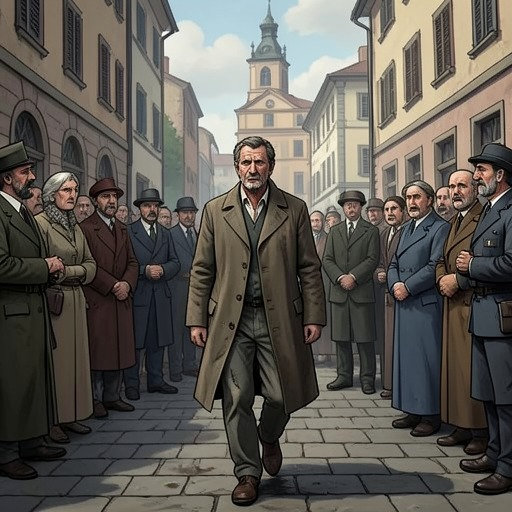
The letter reconstructs the sharp reversal that brought Khlestakov into the Governor’s home. On the road, an infantry captain took his last penny; at the inn, the innkeeper wanted him sent to jail. Then his appearance and dress, which Khlestakov describes as distinctly Petersburg, led the whole town to take him for a governor-general. He reports that he is now staying with the Governor and flirting with both the Governor’s wife and daughter, while still undecided about which to pursue first. He judges the wife more ready to accept his advances.
His account links this sudden welcome to an earlier, humiliating poverty. He reminds Triapichkin of their days of finding meals wherever they could without paying. On one occasion, a pastry cook seized him by the collar because Khlestakov had charged the pies he ate to the King of England. Against that recollection, the town’s current readiness to lend him whatever money he asks for appears not as proof of his authority but as proof of how completely the officials have mistaken him. The letter’s comic force comes from the distance between the man who once could not pay for pies and the supposed official whose expenses are met by frightened subordinates.
Khlestakov presents the townspeople as extraordinary and amusing, and urges Triapichkin, who writes for the papers, to put them into print. He begins to supply his friend with material by ridiculing the Governor as stupid. The letter thus turns the town’s deference into an object of public mockery even as Khlestakov enjoys its benefits. His description is not a confession of wrongdoing or a warning to the officials; he is sharing an entertaining success with a friend and inviting him to make it literary material.
Interception and Exposure
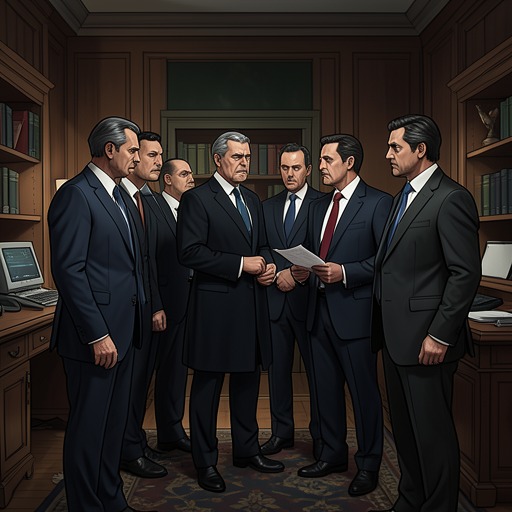
The postmaster opens the letter after seeing the address to Pochtamtskaya Street. He suspects that Khlestakov has discovered something wrong in the post office and is reporting it to the government, so he breaks the seal rather than simply forwarding the letter. His explanation repeats the same structure of fear and misinterpretation that governs the town: even a private address looks to him like a possible channel of official surveillance. The letter reaches the assembled officials not because Khlestakov intended them to read it, but because the postmaster’s anxiety prompts him to violate its privacy.
Read aloud, the letter overturns the officials’ confident picture of their visitor. The man they have treated as a powerful inspector identifies himself, in his own account, as a traveler whose remaining money was taken by a captain and who was nearly jailed over an inn bill. He says that the town mistook his appearance for authority and that he has accepted its loans and the Governor’s hospitality. The document supplies the explanation the officials had not obtained through their own inquiries: there has been no confirmation of Khlestakov’s supposed rank in his letter, only his report that the townspeople assigned him one.
The letter also gives a private view of the household courtship that the officials have watched with awe. Khlestakov tells Triapichkin that he is flirting with the Governor’s wife and daughter and weighing which to pursue first. In the town, his proximity to ministers and the court has already encouraged Anton Antonovich Skvoznik-Dmukhanovsky to imagine advancement to a generalship. The letter’s casual account of Khlestakov’s behavior makes that imagined connection look as hollow as the supposed official identity on which it rests.
Form and Significance
As a letter, the document carries Khlestakov’s own account across the divide between his private intentions and the officials’ public performance. Its informal address to Triapichkin and its anecdotes about debts, meals, and flirtation bring the apparent inspector down to the level of a young man amused by a lucky mistake. The contrast is structural as well as comic: the officials have treated every gesture as evidence of rank, while Khlestakov has treated their fear as an opportunity for comfort, money, and entertainment.
The letter’s candor should not be confused with a full or neutral account. Khlestakov writes to amuse a friend and promote a story for the newspapers; he selects details that make the town ridiculous and himself fortunate. Yet even this self-serving performance reveals the essential facts. The officials’ behavior has made an imposture possible, and Khlestakov’s letter makes their credulity impossible to sustain. In exposing the gap between the authority they imagined and the precarious traveler who wrote to Triapichkin, the document gathers the play’s mistaken identity, social comedy, and scrutiny of local officialdom into a single object.